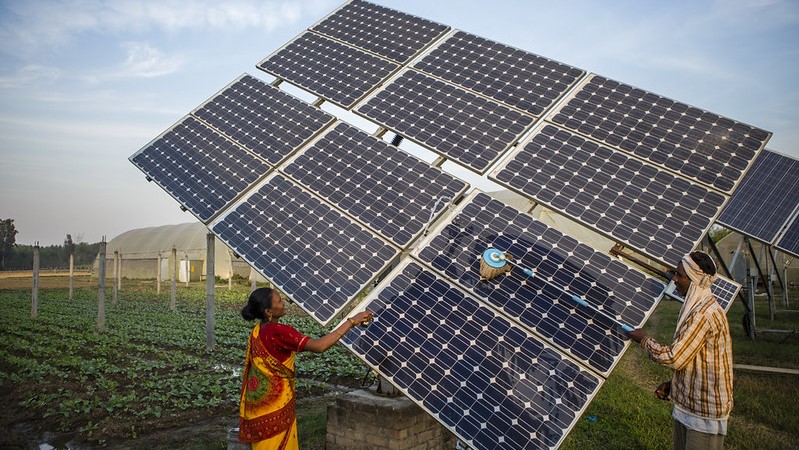
How can India become a Solar power center of the world?
India, a country known for its diversity, has long been struggling with power shortages and high energy prices. However, with the increasing awareness of climate change and the need to transition to renewable energy sources, India has the potential to become a solar power center of the world. With its abundant solar resources, India can harness the power of the sun to meet its growing energy demands and become a global leader in solar energy production.
India’s solar potential is immense, with vast tracts of land available for solar power plants and an average of 300 days of sunshine per year. The country has set an ambitious target of achieving 175 GW of renewable energy capacity by 2022, of which 100 GW is to come from solar power. This target has now been raised to 450 GW by 2030, with a focus on solar power.
To achieve this goal, India needs to adopt a multi-faceted approach. Currently, India has installed 119 gigawatts of solar, wind, bio-power and small hydro power capacity against a target of 175 gigawatts for 2022.
The first step is to make solar energy more accessible and affordable to the masses. India has already made significant progress in this area by introducing various government schemes such as the Pradhan Mantri Kisan Urja Suraksha evam Utthan Mahabhiyan (PM-KUSUM) and the Atal Jyoti Yojana (AJAY) to promote solar energy in rural areas.
However, more needs to be done to promote rooftop solar installations in urban areas, which can help to reduce the burden on the grid and make solar energy more accessible to households and businesses.
Secondly, India needs to focus on research and development to improve solar energy technology and reduce the costs of solar power production. The country has already made significant progress in this area, with the development of the world’s largest solar park in Kurnool, Andhra Pradesh, and the world’s largest floating solar power plant in Kerala.
However, more needs to be done to develop innovative solar technologies and improve the efficiency of solar panels.
Thirdly, India needs to address the issue of energy storage, which is critical for the adoption of solar energy. Energy storage systems such as batteries can help to store excess solar energy generated during the day and supply it to the grid during peak demand hours.
The government has already introduced various policies and incentives to promote energy storage, but more needs to be done to make energy storage affordable and accessible to the masses.
Fourthly, India needs to encourage private investment in solar energy. The government has already taken various steps to attract foreign investment in the renewable energy sector, such as the introduction of tax incentives and the establishment of a renewable energy investment fund.
However, more needs to be done to create a conducive environment for private investment in solar energy.
Finally, India needs to promote international cooperation in the renewable energy sector. The country has already taken significant steps in this direction, such as the formation of the International Solar Alliance (ISA) in 2015.
The ISA is a platform for cooperation among countries that are rich in solar resources to share their experiences and expertise in the field of solar energy. India needs to continue to play an active role in promoting international cooperation in the renewable energy sector to become a solar power center of the world.
In conclusion, India has the potential to become a solar power center of the world with its abundant solar resources and ambitious targets for solar energy production.
However, to achieve this goal, India needs to adopt a multi-faceted approach that includes making solar energy more accessible and affordable, investing in research and development, addressing the issue of energy storage, encouraging private investment, and promoting international cooperation. With the right policies and incentives, India can become a global leader in solar energy production and pave the way for a sustainable future.
–BY AVNI