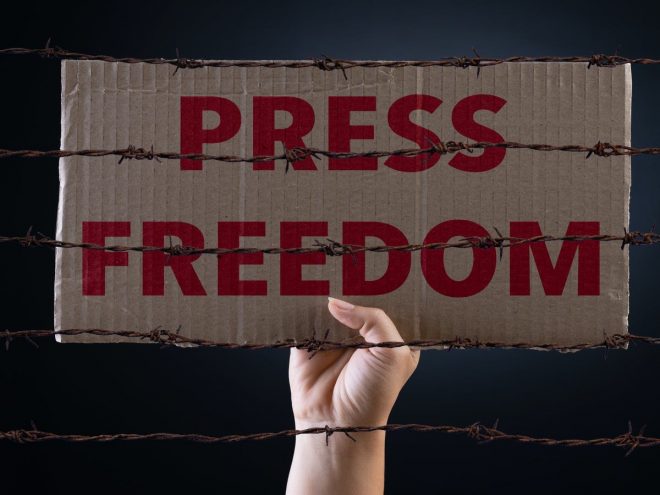
Press freedom is one of the cornerstones of any democracy. It enables journalists and media organizations to investigate and report on important issues without fear of reprisal or censorship. However, in recent years, there have been concerns about the curtailment of press freedom in India.
According to Reporters Without Borders’ 2021 World Press Freedom Index, India ranks 142 out of 180 countries in terms of press freedom. This is a drop of two places from the previous year, indicating a worsening situation.
One of the most notable cases of press freedom curtailment in India in recent years has been the arrest of journalist Siddique Kappan in 2020. Kappan was on his way to cover the Hathras gang-rape case when he was arrested under the Unlawful Activities (Prevention) Act. He has been in jail ever since, with his case repeatedly adjourned.
Another example is the arrest of journalist Arnab Goswami in November 2020. Goswami, who is known for his pro-government stance, was arrested in relation to a 2018 abetment to suicide case. Many journalists and media organizations criticized the timing of the arrest, which came shortly after Goswami had criticized the Maharashtra government on his news channel.
In addition to these high-profile cases, there have been numerous other incidents of press freedom curtailment in India. For example, in 2019, the government of Jammu and Kashmir issued a media advisory asking journalists to avoid “live coverage” of militant attacks or security operations. This led to concerns that journalists in the region would not be able to report on important issues.
There have also been concerns about the use of sedition laws to silence journalists critical of the government. In 2020, journalist Vinod Dua was charged with sedition in relation to a YouTube video he had made criticizing the government’s handling of the COVID-19 pandemic.
These examples highlight a worrying trend of press freedom curtailment in India. Journalists and media organizations should be able to report on issues of public interest without fear of reprisal or censorship. The government should work to create an environment in which the media can operate freely and without interference.
The sedition law is a colonial-era law that criminalizes speech that is deemed seditious, i.e., speech that incites people to rebel against the government. In recent years, the law has been used to arrest journalists and editors who have been critical of the government.
Another concern is the increasing use of defamation laws to silence critical voices. Indian laws are notoriously strict when it comes to defamation, and the government has been accused of using these laws to intimidate and silence journalists. In 2020, the government passed new guidelines allowing for the prosecution of journalists who report “fake news” or “anti-national” content.
In conclusion, while India may have a vibrant and diverse media landscape, the curtailment of press freedom in recent years is a cause for concern. Journalists must be allowed to operate freely and report on important issues without fear of arrest or harassment. It is essential that the government takes steps to safeguard press freedom and protect the role of the media in a democracy as media serves as watchdog of democracy.
–BY ANKIT SAINI